
Why I'm Sharing My Birth Stories
Before becoming a doula, I was a mother navigating my own birth experiences.
My two births looked very different from one another. One involved an induction, a long labor, multiple interventions, and difficult decisions along the way. The other was fast, instinctive, and largely intervention-free. Neither birth unfolded exactly the way I imagined, yet both taught me valuable lessons about trust, flexibility, advocacy, and the importance of having the right support.
One of the greatest gifts during both of my labors was having a doula by my side. She provided encouragement when things became difficult, offered guidance when I felt uncertain, and helped me navigate decisions with confidence. Her support reminded me that birth is not about achieving a perfect plan. It is about feeling informed, respected, and empowered throughout the process.
These experiences are part of what inspired me to become a doula myself. Having walked through both an intervention-heavy birth and a low-intervention birth, I understand firsthand that every labor journey is unique. My goal is not to help clients achieve one particular type of birth, but to support them as they make informed choices, navigate unexpected turns, and welcome their babies with confidence in God's intentional design. I hope these stories encourage you as you prepare for your own birth journey.
My First Birth Story
Finding Beauty in an Unexpected Birth
As I prepared to meet my first baby, I prayed for a peaceful, low-intervention birth. My desire was to work with my body, trust the process God designed, and welcome my baby into the world with as few interventions as possible. While I knew birth could be unpredictable, I hoped for a straightforward labor and trusted that God would guide us through whatever lay ahead.
At 36 weeks, I went to what I expected would be a routine appointment. Instead, I learned that my blood pressure was high. I was admitted to the hospital and stayed overnight and into the following day while I was monitored for signs of preeclampsia. When high levels of protein were found in my urine, my care team recommended an induction.
Suddenly, the birth I had imagined was beginning several weeks early and under very different circumstances. I had to let go of some of my expectations and trust that God would meet me in a situation I had not planned.
The induction began around 9 p.m. with Cytotec to help prepare my cervix. For a while, things were quiet. I rested, watched TV, ate, and eventually took a shower. Pitocin was started the following afternoon.
The nurse told me I was having strong contractions and seemed especially sensitive to the Pitocin, but I could not feel much at first. My amniotic fluid was still cushioning the contractions, allowing my body to work while I remained relatively comfortable.
Although the contractions looked intense on the monitor, my labor progressed slowly. Because my blood pressure remained a concern, my care team discussed giving me magnesium. After further conversation, the OB on call decided it was not necessary at that point because my blood pressure was not consistently high.
One of the things I value most when I look back on this birth is that I was able to ask questions and participate in these decisions. I was learning that informed birth support does not mean refusing every intervention. It means understanding what is being recommended, asking why, and having space to consider your options whenever circumstances allow.
Around 4 p.m., my midwife broke my water in hopes of helping labor progress.
Almost immediately, everything changed.
I went from feeling very little to having intense, minute-long contractions with less than a minute of rest between them. My blood pressure spiked with each contraction, and I quickly realized I needed more support. I called my doula and asked for an epidural. Both arrived around 5 p.m.
An epidural had not been part of my original plan, but it became an important tool during this birth. Once it took effect, my blood pressure returned to a normal range and my body was finally able to relax. That rest helped me progress to 9 centimeters.
Then my labor stalled.
By around 8 p.m., I was still at 9 centimeters, and I remained there for hours. A cesarean was offered, but I wanted to avoid one if my baby and I were stable and there was still a reasonable opportunity to continue laboring.
This was when my doula’s support became especially valuable. She helped me remain focused when I was tired and unsure of what would happen next. She worked alongside my nurse to guide me through several positions designed to encourage my labor to progress and help my baby move into a better position.
Monitoring my baby also became more difficult during this time. The external monitor was not consistently picking up the heartbeat, so an internal monitor was placed. My care team also used an intrauterine pressure catheter to monitor the strength of my contractions more accurately.
Eventually, we learned that my baby was in the occiput posterior, or “sunny-side up,” position. This position can make labor and pushing more challenging because the baby may need to rotate before moving down effectively.
My doula and nurse continued helping me try different positions to encourage that rotation. Because my water had already been broken, movement and rotation were more difficult, but they kept working with me. My doula’s presence gave me practical support, but she also gave me reassurance. She helped me keep going when the hours felt long and the outcome remained uncertain.
Through that long night, I had to surrender my timeline and trust God one contraction and one decision at a time.
Around 6 a.m., I finally reached 10 centimeters and was ready to push.
Because my baby was still in the posterior position and I had an epidural, pushing was difficult. I had already decided that I did not want forceps or a vacuum used unless they became absolutely necessary, so I continued pushing with the support of my husband, doula, nurse, and midwife.
I pushed for more than two hours.
Eventually, my midwife told me that she was going to perform an episiotomy. I told her I did not want one. She explained that unless I could push the baby out with the next push, she did not believe there was another option.
By the grace of God, I found the strength for one final, powerful push.
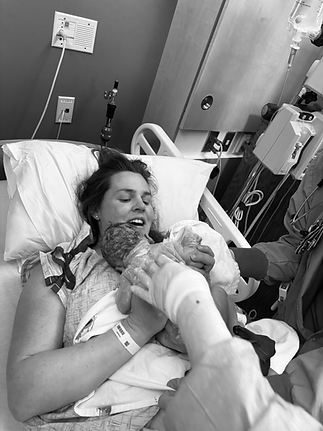
At the same time, my midwife reached in and manually rotated my baby to help with the delivery. At 8:41 a.m., after a long and winding labor, my baby was born.
Looking Back
This was not the birth I had anticipated. It included an early induction, Pitocin, an epidural, additional monitoring, a long stall in labor, difficult pushing, and many conversations about what might need to happen next.
Even so, I do not look back and see a failed plan. I see a birth that required resilience, discernment, and grace.
I was still able to keep some important things within my control. When magnesium was discussed, I asked questions and participated in the conversation. When a cesarean was offered, I asked whether it was safe to continue laboring a little longer. When other interventions were considered, I communicated my preferences.
Not every intervention was something I had originally wanted, but each decision was made in response to the birth that was actually unfolding, rather than the one I had imagined.
My doula helped me navigate that uncertainty. She brought knowledge, calm, encouragement, and practical ideas into the room. She helped me change positions when progress stalled, supported my desire to continue laboring, and reminded me that I was not alone during some of the most difficult hours.
Although I had not planned on receiving an epidural, my husband and I believe it was the right decision under the circumstances. It allowed my body to relax, helped regulate my blood pressure, and gave me the opportunity to keep laboring toward a vaginal delivery.
If I could go back, I might incorporate more movement and position changes earlier in labor, before my water was broken. If possible, I also might wait longer before having my water broken so that my baby had more time and space to rotate.
But birth does not give us the benefit of hindsight in the moment. There is no way to know whether different choices would have led to a different or better outcome.
What I do know is that God was present even when the path looked nothing like the one I had envisioned. This birth taught me that a beautiful birth is not necessarily one that follows a perfect plan. Sometimes beauty is found in adapting, asking questions, accepting help, and discovering strength you did not know you had.
My first birth was complicated, exhausting, and full of unexpected turns. It was also the day I became a mother. For that, I will always be grateful.
My Second Birth Story
Trusting My Body and Carrying the Lessons Forward
As I prepared for the birth of my second baby, I carried both the lessons and confidence I gained from my first birth. My goal was again a low-intervention birth, but this time I had a deeper understanding of how I wanted to approach labor. I wanted to move freely, listen to my body, and give labor space to unfold naturally whenever it was safe to do so. Above all, I trusted that God had been preparing me through my first birth for whatever this birth would bring and that He would still be present through it all.
One choice was especially important to me. If possible, I wanted to wait for my water to break on its own. My first birth had taught me how quickly labor could intensify after my water was broken. This time, I hoped to give my baby more time to move and rotate while still cushioned by the amniotic fluid.
At my 40-week appointment, I learned that my blood pressure was high. My cervix was already about 3 centimeters dilated, and because it was my due date, my midwife recommended an induction.
Although another induction was not necessarily what I had imagined, this time I entered the experience with more knowledge and confidence. I was able to return home first, where I showered, ate, and waited for Grandma to arrive for babysitting duty.
My husband and I arrived at the hospital around 10 p.m., and Pitocin was started around 10:30 p.m. When my midwife checked my cervix, she found that I was already about 5 centimeters dilated.
She asked whether I wanted her to break my water.
Because of my first experience, I knew that I wanted to wait. I asked to give my water the opportunity to break on its own, and my care team supported that decision.
As the Pitocin began working, I was able to rest for a while. Around 1 a.m., the contractions started becoming uncomfortable. Then, at approximately 1:45 a.m., my water broke on its own.
From that moment, labor moved quickly.
Over the next hour, my contractions became longer, stronger, and closer together. I sat on a birth ball while my husband and the nurse comforted me. At one point, I threw up, which was a clear sign that my body was working hard and labor was becoming more intense.
My husband helped me change positions, and around 2:45 a.m., I asked him to call my doula.
She arrived at 3:17 a.m., exactly one hour before my baby was born.
Although she was only physically present for that final hour, her support had a tremendous impact. She helped me move through two or three different positions and find ways to work with each contraction. In the final position, I leaned forward over a birth ball placed on the hospital bed.
My doula remained calm and steady beside me. She reassured me, reminded me that I was capable, and offered quiet words of encouragement through each contraction. She did not take over the experience. Instead, she helped me feel safe enough to trust my body and continue doing the work it already knew how to do.
Around 4:05 a.m., I asked for a cervical check. Labor had become very intense, and I wanted to know how far I had progressed.
The nurse told me I was 8 centimeters.
Somehow, that felt comforting and discouraging at the same time. I was relieved that I had made significant progress, but in that moment, I could not imagine continuing through another two centimeters. I even asked whether it was too late for an epidural.
Not long after that check, however, I felt an overwhelming urge to push.
My intuition told me that I needed to lie on my side, so I moved into a side-lying position. Everyone told me, “No, wait!”
But my body had other plans.
“Nope, I can’t,” I responded.
For one brief moment, fear took over. I screamed as my mind returned to the long, difficult pushing experience of my first birth. I worried that I was about to face the same exhausting struggle all over again.
But this was not my first birth.
My baby was in a more favorable position. I could feel what my body was doing, and I was able to follow its cues. My midwife quickly put on her gown and prepared for the birth.
Two pushes later, my baby was here.
My baby was born at 4:17 a.m., just 12 minutes after I had been told I was 8 centimeters.
I immediately held my baby skin to skin. My baby completed the breast crawl and began nursing soon after birth. The placenta followed shortly afterward.
The experience felt almost surreal. After such a long and complicated first labor, I could hardly believe how quickly this baby had arrived.
Looking Back
With the exception of that brief moment of panic, I could not have asked for my second birth to have gone much better.
Aside from Pitocin, the birth was free from additional interventions. I had only two cervical checks, my water broke on its own, and I was able to move, change positions, and listen to my body.
Waiting for my water to break naturally was one of the most meaningful choices I made. It gave me a couple of additional hours in which labor was progressing while my baby remained cushioned by the amniotic fluid. That part of labor felt more manageable, and by the time my water broke, my body was ready to move quickly.
My baby was also in the favorable occiput anterior position, which made pushing feel completely different from my first experience. Without an epidural, I could clearly feel my body’s signals and follow the instinct to move onto my side and push.
My doula’s presence helped me stay grounded through the most intense portion of labor. Her calm voice, encouragement, and confidence helped quiet my fear and reminded me that I could trust what my body was doing. Even though she was there for only the final hour, it was the hour in which I needed her most.
My husband also supported me throughout the night, helping me move, comforting me, and staying close as our baby’s arrival drew near. Together, my birth team created an environment in which I felt supported, respected, and safe.
I am grateful that God gave me the opportunity to carry the lessons of my first birth into my second. My first experience taught me to ask questions, consider my options, and remain flexible. My second gave me the chance to use that knowledge in a new way.
The two births could hardly have been more different.
My first was long, complicated, and filled with unexpected interventions. My second was fast, instinctive, and nearly intervention-free. One required me to surrender my original expectations and accept support in ways I had not anticipated. The other allowed me to trust my body and experience the kind of birth I had hoped for.
Both births taught me something about strength. Both reminded me that support matters.
And both showed me that God can bring beauty through very different stories.
Birth is not beautiful only when everything goes according to plan. Sometimes its beauty is found in changing course with courage. Sometimes it is found in advocating for more time. Sometimes it is found in accepting an epidural that allows your body to rest.
Sometimes it is found in following the sudden, unmistakable urge to push.
Every birth unfolds differently. What matters is not achieving one particular kind of experience, but feeling informed, supported, respected, and surrounded by people who help you face each new moment with confidence. I am grateful for both of my birth stories. Together, they shaped not only the way I understand birth, but also the kind of support I hope to offer other mothers as they prepare to meet their babies.
A Final Reflection
When I look back at both of my births, what stands out most is not the differences in how they unfolded, but the support that carried me through them. One birth taught me how to navigate unexpected challenges. The other showed me what it felt like to trust my body and follow its instincts. Both reminded me that birth is unpredictable, that plans sometimes change, and that having knowledgeable, compassionate support can make all the difference.
I truly believe God meets us in every birth story, not because everything goes according to plan, but because His faithfulness remains steady even when the journey takes unexpected turns.